Note : SOLID in Go
Source from : https://towardsdev.com/golang-solid-principles-fd7bf513874d
1. Single responsability 單一職責
— Definition: "A module should have one, and only one reason to change"
Bad
package main

import (
    "fmt"
    "math"
)

type circle struct {
    radius float32
}

func (c circle) area() {
    fmt.Printf("circle area: %f\n", math.Pi*c.radius*c.radius)
}

type square struct {
    sideLen float32
}

func (s square) area() {
    fmt.Printf("square area: %f\n", s.sideLen*s.sideLen)
}

func main() {
    c := circle{radius: 5}
    c.area()

    s := square{sideLen: 2}
    s.area()
}
good
package main

import (
    "fmt"
    "math"
)

type shape interface {
    area() float32
}

type outPrinter struct{}

func (ou outPrinter) toText(s shape) string {
    return fmt.Sprintf("the area is : %f", s.area())
}

type circle struct {
    radius float32
}

func (c circle) area() float32 {
    return math.Pi * c.radius * c.radius
}

type square struct {
    sideLen float32
}

func (s square) area() float32 {
    return s.sideLen * s.sideLen
}

func main() {
    c := circle{radius: 5}
    // c.area()

    s := square{sideLen: 2}
    // s.area()

    out := outPrinter{}
    fmt.Println(out.toText(c))
    fmt.Println(out.toText(s))
}
圖形定義了算面積的操作, 而不做印出字錯 類型 outPrinter 將定義所有需要生成所需的字符串輸出
2. Open-Close principle 開放關閉原則
— Definition: "A software artifact should be open for extension but closed for modifications"
Bad
package main

import (
    "fmt"
    "math"
)

type circle struct {
    radius float32
}

type square struct {
    sideLen float32
}

type calculator struct {
    total float32
}

func (c calculator) sumAreas(shapes ...interface{}) float32 {
    var sum float32

    for _, shape := range shapes {
        switch shape.(type) {
        case circle:
            r := shape.(circle).radius
            sum += math.Pi * r * r
        case square:
            l := shape.(square).sideLen
            sum += l * l
        }
    }
    return sum
}

func main() {
    c := circle{radius: 5}
    s := square{sideLen: 2}
    calc := calculator{}
    fmt.Println("total of areas", calc.sumAreas(c, s))
}
Good
package main

import (
    "fmt"
    "math"
)

type shape interface {
    area() float32
}

type circle struct {
    radius float32
}

func (c circle) area() float32 {
    return math.Pi * c.radius * c.radius
}

type square struct {
    sideLen float32
}

func (s square) area() float32 {
    return s.sideLen * s.sideLen
}

type calculator struct {
    total float32
}

func (c calculator) sumAreas(shapes ...shape) float32 {
    var sum float32

    for _, shape := range shapes {
        sum += shape.area()
    }
    return sum
}

func main() {
    c := circle{radius: 5}
    s := square{sideLen: 2}
    calc := calculator{}
    fmt.Println("total of areas", calc.sumAreas(c, s))
}
calculator type 的 sumAreas 方法, 他參數定義了 shapes 的類型為 interface{}.
此時他用switch來映射每一個可能的類型, 這邊就會出問題了, 假如出現了新的一個形狀, 譬如三角形
此事就緒要修改 sumAreas方法來處理新類型
3. Liskov substitution principle 里氏替換原則
— Definition: "What is wanted here is something like the following substitution property: If for each object o1 of type S there is an object o2 of type T such that for all programs P defined in terms of T, the behavior of P is unchanged when o1 is substituted for o2 then S is a subtype of T"
若對型態 S 的每一個物件 o1,都存在一個型態為 T 的物件 o2,使得在所有針對 T 編寫的程式 P 中,用 o1 替換 o2後,程式 P 的行為功能不變,則 S 是 T 的子型態。 子型態必須遵從父型態的行為進行設計
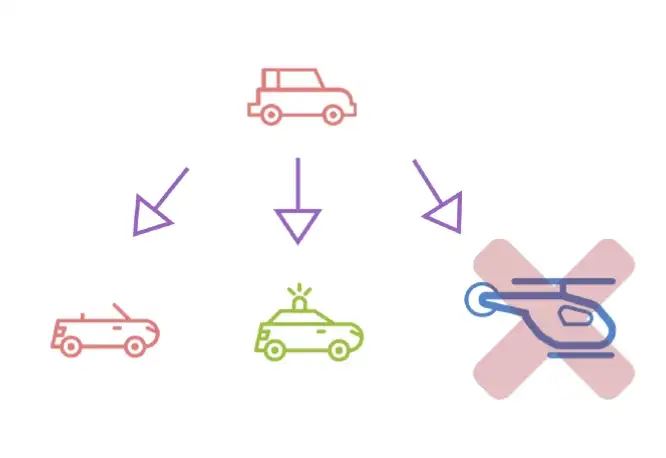 source: https://towardsdev.com/golang-solid-principles-fd7bf513874d
package main

import "fmt"

type transport interface {
    getName() string
}

type vehicle struct {
    name string
}

func (v vehicle) getName() string {
    return v.name
}

type car struct {
    vehicle
    wheel int
    gates int
}

type motocycle struct {
    vehicle
    wheel int
}

type printer struct {
}

func (printer) printTransportName(p transport) {
    fmt.Println("Name:", p.getName())
}

func main() {
    v := vehicle{name: "Ford"}
    c := car{
        vehicle: vehicle{name: "car-name"},
        wheel:   4,
        gates:   2,
    }

    m := motocycle{
        vehicle: vehicle{name: "motocycle-name"},
        wheel:   2,
    }

    p := printer{}
    p.printTransportName(v)
    p.printTransportName(c)
    p.printTransportName(m)
}
4. Interface segregation 介面隔離原則
— Definition: "Clients should not be forced to depend on methods they don't use" 你不應該去依賴你根本不會用到的東西, “Keep interfaces simple, preferable just one method”
Bad
type sahape interface {
    area() float64
    volume() float64
}

func (s square) area() float64 {
    return s.sideLen * s.sideLen
}

func (s square) volume() float64 {
    return 0
}

type cube struct {
    sideLen float64
}

func (c cube) area() float64 {
    return math. Pow(c. sideLen, 2)
}

func (c cube) volume() float64 {
    return math. Pow( c. sideLen, 3)
}

// sum the shapes areas
func areaSum (shapes ...shape) float64 {
    var sum float64
    for _, s := range shapes {
        sum += s.area ( )
    }
    return sum
}

// areaVolumeSum sum the shapes volumes
func areaVolumeSum(shapes ... shape) float64 {
    var sum float64
    for _, s := range shapes {
        sum += s.area() + s.volume()
    }
    return sum
}
這段程式有個問題 Square 不需要 volume function, 只有cube需要volume function
Good
type shape interface {
    area float64
}

type object interface {
    shape
    volume ( ) float64
}

type square struct {
    sideLen float64
}

func (s square) area() float64 {
    return math.Pow(s.sideLen, 2)
}

type cube struct {
    square
}

func (c cube) volume() float64 {
    return math. Pow(c. sideLen,3)
}

// sum the shapes areas
func areaSum (shapes ...shape) float64 {
    var sum float64
    for _, s := range shapes {
        sum += s.area ( )
    }
    return sum
}

// areaVolumeSum sum the shapes volumes
func areaVolumeSum(shapes ... object) float64 {
    var sum float64
    for _, s := range shapes {
        sum += s.area() + s.volume()
    }
    return sum
}
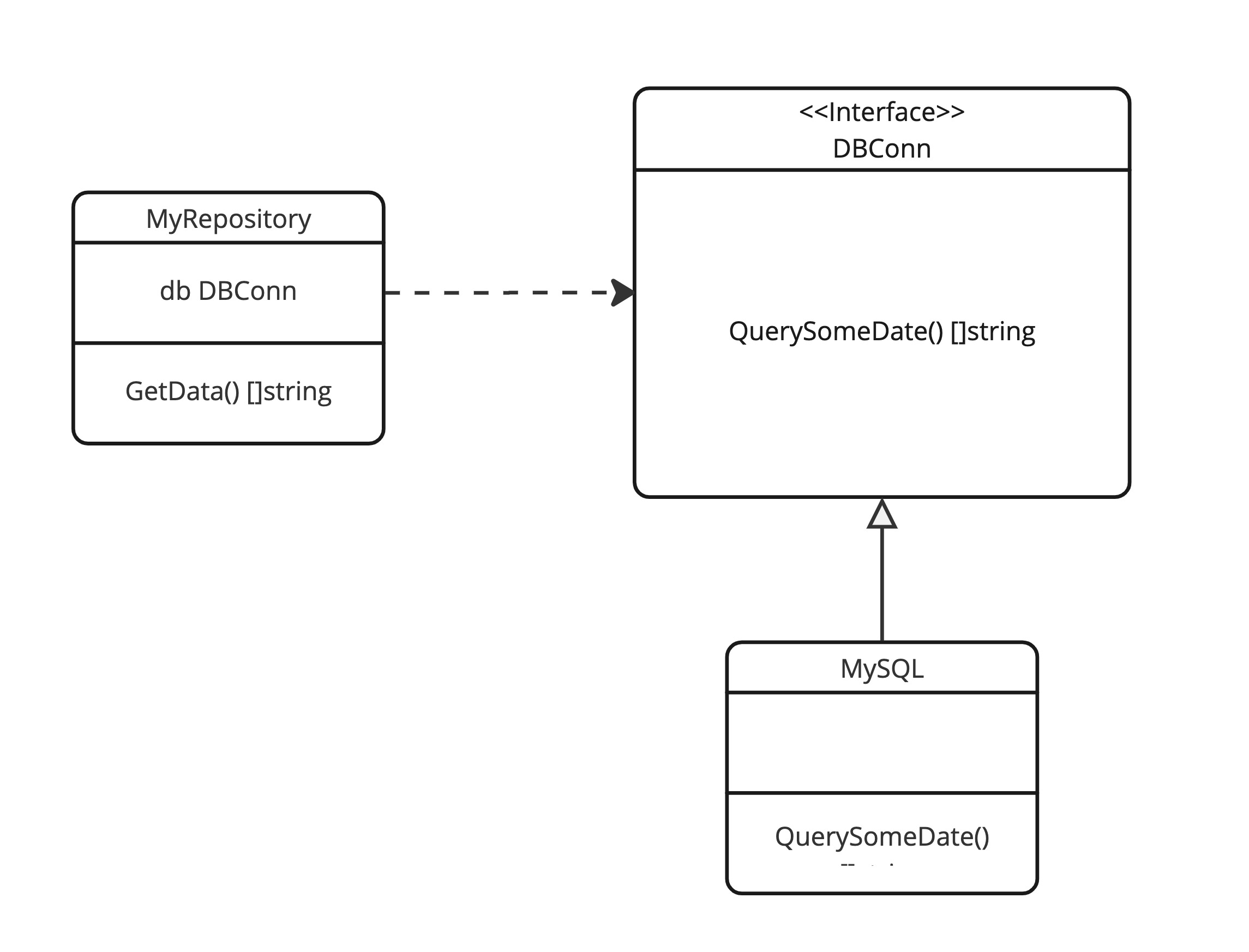
5. Dependency inversion 依賴反轉原則
— Definition: "High-level modules should not depend on low-level modules. Both should depend on abstractions. Abstractions should not depend on details. Details should not depend on abstractions"
- 高層次的模組不應該依賴於低層次的模組,兩者都應該依賴於抽象介面。
- 抽象介面不應該依賴於具體實現。而具體實現則應該依賴於抽象介面。
Bad
該代碼不符合該原則,因為它在MyRepository中定義了 access the query method 的結構類型.
type MyRepository struct {db MySQL}
package main

import "fmt"

// Defines the database connection
type MySQL struct {
    // some properties here
}

func (db MySQL) QuerySomeDate() []string {
    return []string{"info1", "info2", "info3"}
}

type MyRepository struct {
    db MySQL
}

func (r MyRepository) GetData() []string {
    return r.db.QuerySomeDate()
}

func main() {
    mysqlDB := MySQL{}
    repo := MyRepository{db: mysqlDB}
    fmt.Println(repo.GetData())
}
Good
package main

import "fmt"

type DBConn interface {
    QuerySomeDate() []string
}

// Defines the database connection
type MySQL struct {
    // some properties here
}

func (db MySQL) QuerySomeDate() []string {
    return []string{"info1", "info2", "info3"}
}

type MyRepository struct {
    db DBConn
}

func (r MyRepository) GetData() []string {
    return r.db.QuerySomeDate()
}

func main() {
    mysqlDB := MySQL{}
    repo := MyRepository{db: mysqlDB}
    fmt.Println(repo.GetData())
}